Our MEAN STATIONS series where Berlin’s most iconic U-Bahn stations are reimagined through our streetwear. Each T-Shirt in our Berlin camo series tells a different story and this week it’s the Ernst-Reuter Platz T-shirt. This place means a lot to us since the area in West Berlin is where we first started MEAN BERLIN. We call it Ernsti!
Going Underground: Our Ernsti collaboration with Anton Hangschlitt
One of our favourite projects so far at MEAN BERLIN was teaming up with Anton Hangschlitt to shoot the Ernst-Reuter-Platz Camouflage drop. We went underground where this T shirt belongs, in the tunnels, platforms, and corridors of Ernst-Reuter Platz.

This photo series features Greta wearing our ‘Ernsti Camo’ in the U-Bahn station underneath the busy roundabout above. As reflected in our T-Shirt, the station offers a consistently clean and cool feel. It is not traditionally beautiful but structured and cold and very Berlin. This matched Anton’s work, which shows Berlin’s brutalist cold aesthetic in the most beautiful way possible.
We’d admired Anton’s work for a while. He has been photographing the raw aesthetic beauty of Berlin’s U Bahn stations for years. You’ve probably come across his photos: empty stations, flickering fluorescent lights and blurred commuters. If you haven’t, check out Anton here. His work is about capturing Berlin in motion and transition documenting the city’s underground spaces with an eye for geometry, symmetry and mood. This links up with what we want to do with our streetwear, to create clothes that capture Berlin’s atmosphere.
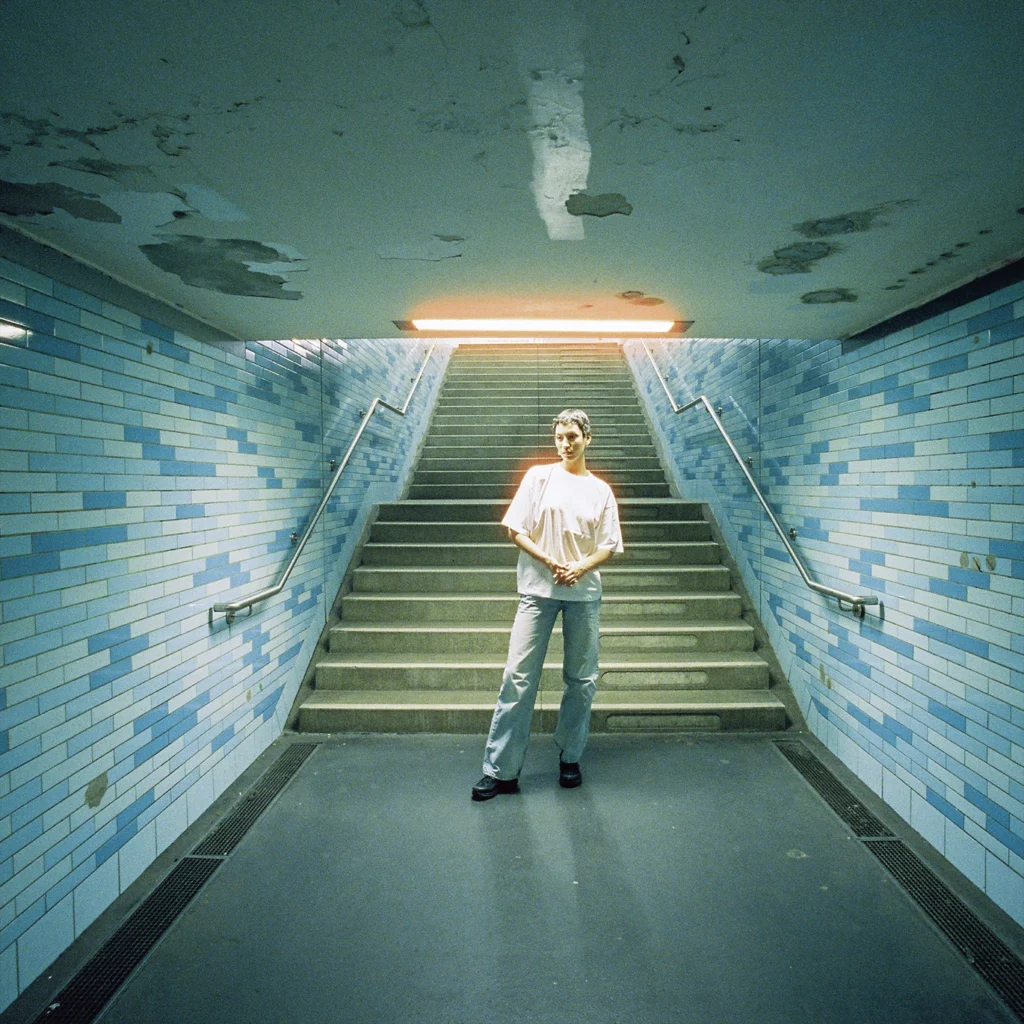
The Ernst-Reuter-Platz T-shirt: The cool underground
The second release in the MEAN camo series is inspired by the colours of the U2’s Ernst-Reuter-Platz station. Our T-shirt is inspired by the clean structured vibe of Ernst-Reuter-Platz. We’ve used its cold tones: ice blue, aqua, grey. The palette captures the understated cool of West Berlin design.
We took these elements and infused them into our ‘MEAN’ camo logo, keeping the city’s “urban jungle” legacy alive. As with all pieces in this series, the station’s geographic coordinates are subtly printed on the neckline.
An area in Motion: The Architecture of Rebuild
The station in Charlottenburg was built in 1902 as part of the city’s first U-Bahn line. Once called Knie or Knee for its sharp curve, this spot became a defining landmark in West Berlin’s history It was re-named in 1953 after the first mayor of West Berlin and reflected West Berlin’s wish to define its identity in the face of Cold War division.

Ernst-Reuter-Platz in motion, 1960
Moving on to September 1960, Berlin’s mayor Willy Brandt switched on 41 illuminated water fountains on the central island of the square in front of thousands of spectators. Die Welt announced ‘Berliners can congratulate themselves on this representation worthy of a capital city’. The square held great significance for West Berliners and was considered an icon of a progressive West Berlin.
The roundabout and the surrounding buildings above the station are a great example of the urban planning of post war modernism. One example that you could check out is the IBM building built between 1960 and 1962 by the architect Rolf Gutbrod. The building brought in a new kind of monumentality, based on the experience of space, not on symbols of the past. The modernity took the form of high-rise administrative buildings of ground-breaking tech companies and bright street lights on high poles.
Ernst-Reuter-Platz Today
A key link to other parts of the city for West Berliners. Head East and you have Der Grosse Stern and Brandenburg Tor and West, Charlottenburg and the Deutsche Oper. Whether you’re off to a Hertha BSC game at the Olympic stadium on the U-Bahn or heading to Kreutzberg for a beer this is a crucial link to all areas of the city for West Berliners.
For many years architectural critics saw the square as a mistake. But in 2019 the central island was revitalized by events and exhibitions in the BHR OX Bauhaus pavilion, constructed from original window elements from the Bauhaus building in Dessau. The area around the square is taken up by Technische Universität Berlin and the Universität der Kunst. Both are world famous institutions and often host exhibitions, sharing ideas.
Top Things To Do Near Ernst-Reuter-Platz
Grab a drink at Schwarzes Café: Open 24/7 since 1978, Schwarzes Café has a true West Berlin vibe. David Bowie was a regular here during his Berlin years. These days it attracts a mix of artists, students, and there’s always someone interesting to speak to. They say Berlin never sleeps and Schwarzes Café definitely doesn’t.
Visit the Bauhaus-Archiv: As soon as you leave Ernst-Reuter-Platz U-Bahn station you will see the Bauhaus-Archiv. It is dedicated to one of the most influential design schools in history, the one we all know. If you’re into architecture, furniture, or typography you should visit.
Visit the Efremidis Gallery: Based in the former IBM building mentioned earlier in the blog, the gallery opened in 2018. Exploring the post modernist building adds to the experience and the exhibitions curated are varied, from emerging to established artists all over the global art world.
Explore TU Berlin’s campus: Home to future engineers, architects, and designers, TU Berlin offers public exhibitions and a chance to see projects that can shape the city.
A walk around Tiergarten: Escape the busy roundabout’s chaos with a walk into one of Berlin’s largest and most beautiful green spaces.
Photograph the modernist architecture: Surrounded by 1950s–60s architecture, it’s sharp lines are ideal for followers of brutalist and post-war design.
What’s next?
Each post in the MEAN STATIONS series will continue to explore Berlin’s U-Bahn stations through streetwear places that shaped us, challenged us, and continue to define us and the city.
Interested in Kottsbuser Tor’s history and political activism? Check it out here. Next, it’s across Berlin to Hallesches Tor.
Let us know what Kottsbuser Tor or Ernst-Reuter-Platz mean to you. Share your photos or tell us about the memories you have there. On Instagram or Pinterest.
